. Bright Meadow Farms

Search This Blog

Wednesday, June 01, 2022

Mid-State Wool Grower's Cooperative

 Since I am in Columbus with my car, I decided to visit the Mid-State Wool Grower's Cooperative in Canal Winchester.  With my bike, it would have been too far.  But since I am travelling in air-conditioned comfort today, I stopped by without an appointment.  

They were very gracious.  My first impression was that it was a large industrial building. 


As I opened the door, I saw a "store" on the left.   Many of the items sold in the store are also available on their website. 

I spoke with a woman behind a desk, who was probably very busy doing her work.  Nethertheless, she spoke with me and told me that they mainly operate on consignment, they receive wool from approximately 2500 shepherds or shearers from Maine to Arizona, and then grade it, consolidate it, and ship it to mills in China or elsewhere.   The theory behind the "co-op" is that if multiple producers band together to consolidate their marketing or purchasing power, they will come out better economically. 

Depending on the grade and quality of the wool, the producer receives between 2 cents to 20 cents per pound for medium wools and up to 80 cents per pound for fine wool breeds like Merino, Rambouillet, Targhee and some Corriedale.  In addition, if the producer has filed the proper application with the Farm Service Administration before selling to the co-op, they can receive a federal subsidy.  This year it is 40 cents per pound.  

For reference, I found this information on wool yield per sheep for a  typical Corriedale. "The fleece from mature ewes will weigh from 10 to 17 pounds (4.5-7.7 kg) with a staple length of 3.5 to 6 inches (9-15 cm). The yield percent of the fleece ranges from 50 to 60 percent." and for a Merino, "A Saxon Merino produces 3–6 kg (6.6–13.2 lb) of greasy wool a year, while a good quality Peppin Merino ram produces up to 18 kg (40 lb). Merino wool is generally less than 24 micron (μm) in diameter."   So, the yield from a single sheep can range from 5 to 20 pounds, and varies between 2 cents to 80 cents per pound, or in economic terms, between 10 cents to 16.00 for the wool from a single sheep.  It can take from one to five minutes to shear a sheep, plus of course travel time for the shearer. Or time to load the sheep and take them to the shearer, as some do to consolidate small flocks at one location for the shearer's convenience, since the shearer is the scarce resource.  

In the warehouse, I spoke with Stanley Strode. 


He had a few minutes to talk to me before unloading a truck. He explained that wool comes into one side of the building and is shipped out the other.  The received wool is placed into the large bags you behind him,  and then later after grading the wool, it is packed into bales and stored in the warehouse awaiting shipment. 
It takes about six bags to make one bale.  The various grades of wool are sorted into the warehouse bays. 


I asked him if COVID had affected the business.  He said that yes, apparently there was less worldwide demand for fine dress wool suits when people were not working.  "Demand, demand, demand, that's the name of the game" and that is how commodity prices are set. 

We talked about the availability of shearers.  He said there is only one full-time shearer that he is aware of in Ohio, Sam Cunningham in New Concord.  The rest work as a second job, so availability could be limited.  I later found a list of "wool handlers"  on the website, where Sam's name was listed,  along with another page listing the various methods of marketing wool through the cooperative. 

I left the warehouse and returned to the store.  I purchased a brass sheep bell.  As I talked to the woman at the counter, and she asked me where I was from, I learned that she grew up in an area only a few miles away from my home, and even closer to my grandmother's family, in the old German Church area north of Crestline off SR 586.  I told her my grandmother's name was Klahn, and there is a Klahn road in that area.  Her name was Kris Kinnamon Doyle.  It is truly a small world.  

  She was very nice and talked me into buying a 1-pound bag of medium-grade roving for $13.00.  She said they sell a lot of it to local spinners.  It is quite soft, and I  will be trying it out soon. 


How does your garden grow?

 I had a big rush to get my flats of seedlings planted before I left on my bicycle trip.  Since I returned home last night to recover from pushing the heavy bike against a headwind on a 90-degree day, I thought I would walk around my garden this morning to see how things are going. 

Here is what I found.

Hosta, iris, clematic doing well on west side of house. 

I believe this is Lupine.  Need to verify.  I love the blooms. Later in the year it will have big black pods.


My beans that were planted just before I started my trip have sprouted.


I don't know if the snow peas will have a crop, since I did not plant until mid-April. They like cool weather, not 90-degree days. 

The first strawberry is almost ripe.  I need to do some weeding, but I won't be here. 

I am trying eggplant this year.  Never had success in the past.  We'll see how it goes. 


Cabbage.  Like the peas, cabbage likes cool weather.  I may not get any heads unless I am dedicated about fertilizing and watering when I get home. 

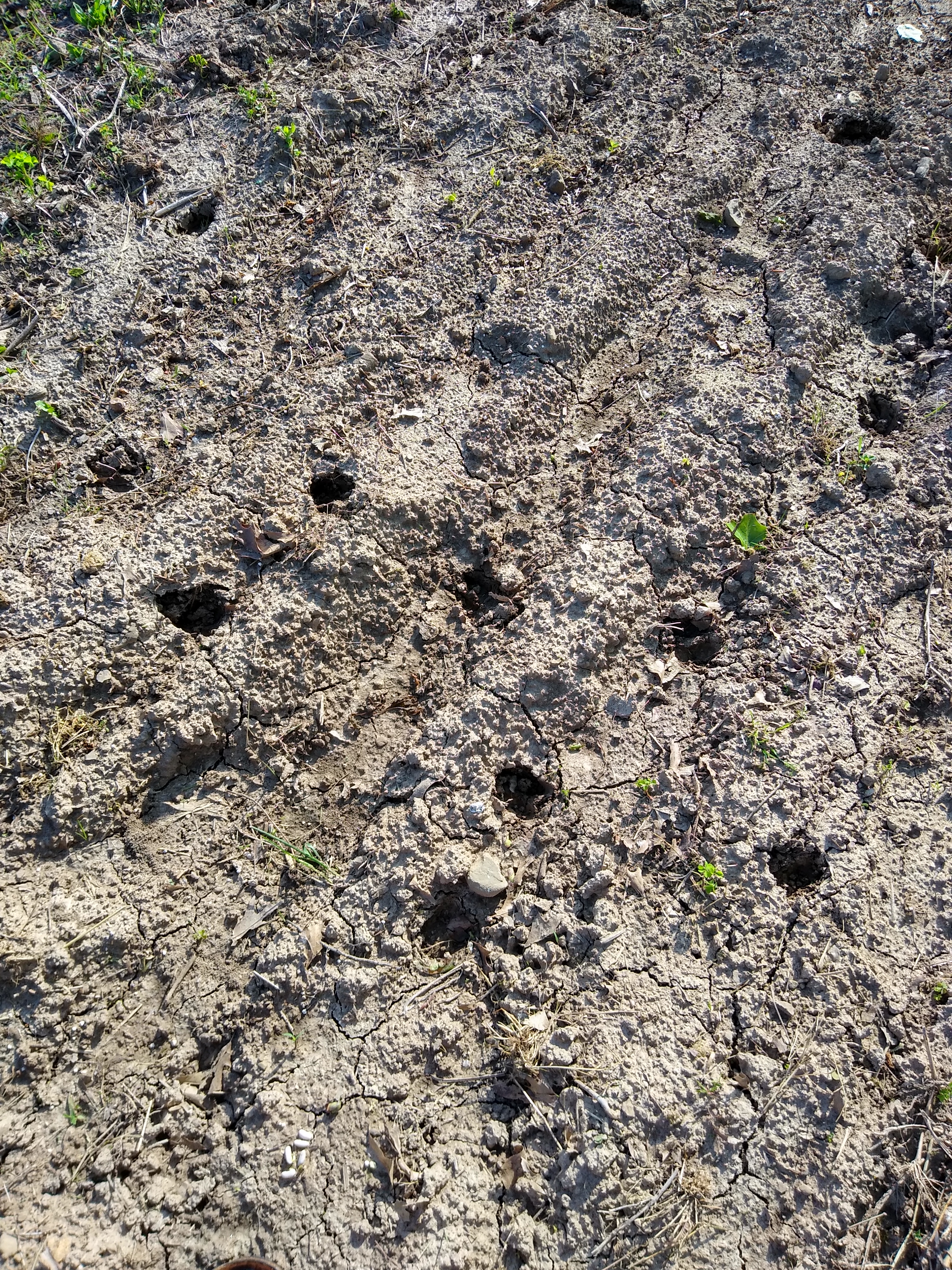
The deer have visited my garden.  Looks like several of them, unless they came, left, and came back.  My daughter and her boyfriend have promised to help my husband put up my deer fence.  It is 8-foot tall plastic 1-inch mesh. It should keep them out.  We take it down every year and then put it up again in the spring. 


The tomato transplants are surviving.  They probably like the weather. I am afraid these may all be cherry tomatoes, I forgot which seedlings I planted. I re-arranged them in April and lost the plant markers. I also have some peppers. 

I picked a bunch of asparagus last two weeks, and now it is time to let it grow. 

I put a border of calendula around the flower beds this year.  The hope is that they will re-seed themselves. 


I planted a small bed of marigolds for color as I drive in the driveway. 


I've also planted a bed of zinnia.  I've been told that they don't like to have their roots disturbed, so starting them as seedlings and transplanting may not be the best approach.  They seem to have survived the transplanting so far. 

I'm raising a pot of herbs (cilantro, basil) and three pots of jalapenos on the deck.  The flower is Lantana, which is a tender perennial.  I hope to move it indoors in the fall and overwinter it. The far right purple plant is transdescantia, which I started from a cutting from our January vacation. Hope it does better on the deck than it did indoors.  


Tuesday, May 31, 2022

A balm in (Mount) Gilead

I recently visited a sheep farm in Mount Gilead, Morrow County, Ohio, as part of a "Yarn Trek by Bicycle".  For information on the bike trip, see this post.  

Roger Cox, along with his wife Jan, was named the 2022 Ohio Charles Boyles Master Shepherd of the year by the Ohio Breed Improvement Association.  They raise mostly Katahdin sheep,  which is a "hair sheep" breed.   This means that they do not have to be shorn every year, as they naturally shed their short wool.  You can see the new coat growing in on this sheep, and the old one shedding off.


The wool is not useful for making yarn, as the fibers are too short for spinning.  I suppose if labor was not prohibitive they could be combed and use for felt or perhaps some industrial purpose, but the economics mean that most shepherds just let the sheep shed into the pasture, which is actually good for the soil.  Everything is recycled. 

The Coxes have over a hundred ewes on their acreage.  Many of the ewes have more than one lamb. Roger explained that his lambing rate last year was over 200%, meaning that several ewes had triplets.  In fact, there was one mother who had quadruplets this year!

Roger has had sheep since he was ten years old, in 1956.  He started with Hampshires, also a meat breed, and has had Dorset/Cheviot crosses.  He and his sons also raised and trained Belgian draft horse teams for some extra income, and later, also raised mule teams.  He started with the Katahdins in 2004, and gradually increased the flock of Katahdins as they were successful, eventually dropping other breeds.   

The Coxes have mostly specialized in breeding stock, instead of concentrating on selling meat for processing.   I remarked how I almost never see lamb at the grocery, except mostly around Easter, and he told me that most of the lamb from the processor  makes its way to cities with higher Muslim and Jewish populations.  I do like lamb, having eaten it especially the year I spent in Spain as a student. But I rarely buy it, since I never see it on the shelf.  Jan mentioned that I should check with Pinhook Meats in Lucas to see if they might have some, as they do some processing for area shepherds.

Roger explained that they chose to concentrate on meat breeds, because the wool industry in this country just doesn't really makes economic sense (my words, not his).  It is difficult to find and schedule shearers before or during the busy lambing season, and it costs more to shear the sheep than the wool brings on the market.  Yet, wool sheep must be shorn, because they have evolved along with humans in a codependent relationship.  The heavy coat of wool is hot, and occasionally the ewe may even smother her lamb by lying on it and not feeling it through a thick coat of wool.  Hair sheep eliminate this problem.  The Katahdin breed, like other hair sheep, has a less gamey taste than some wool sheep.  The breed was developed in Maine by a breeder named Dr. Piel.   (Ironically, the word "Piel" means "skin" (not hair) in Spanish although I have no idea if the breeder is of Spanish heritage.). The breed takes its name from the highest mountain in the state of Maine.  The breed is parasite-resistant, wool-less, and generally have multiple lambs per season.

There is a lot of hard work to do on the farm.  In spring, lambing season begins in April and lasts for about three weeks.  Roger practically lives in the barn for those three weeks, as with 100 ewes, there is always some work to do.  In addition, there is worming each sheep for the barber pole parasite, mucking out stalls, rotating the sheep through the various paddocks, training the border collie, and occasionally plowing a paddock to reduce the risk of parasites. Not to mention mowing the pastures, baking the hay, and keeping the lawn mowed.   Very busy life for a 76-year old! 

Rotational grazing has been a practice that the Coxes have turned to and found that it is very good for the land. They keep the sheep in one paddock for 5 days, then keep them out of that paddock for about 30 days.  This lets the grass recover, and also helps with parasite management.  They raise some cereal crops, and also, purple-top turnips as it is nutritious and also has a high nitrogen content when turned into the soil after grazing. 

The Coxes have three sons and a daughter, and one of the sons, as well as the grandson, has followed him into shepherding. Two other sons are employed in ag-related industries, one in a local factory, and his daughter works in admissions at the Ohio State Branch in Marion.  It is heartening to see a family farm that is passed down through multiple generations.

We spoke briefly about current events and how inflation is affecting everyone.  It is reminiscent of the early 1980's when a high rate of inflation and unfavorable economic conditions sent many farmers to bankrupcy. Some lost everything, including one of the Cox's neighbors.  I pray the current economic situation resolves soon.

The Coxes were very kind and hospitable people.  They made sure I was rested and hydrated from my bike ride before we launched into our discussion and tour. And they insisted on feeding me before I said goodbye.  Roger mentioned how blessed their family has been to increase their flocks and provide a living for his family.  He gives back to the community by occasionally mentoring younger shepherds and getting them set up with livestock.   I can see that he and Jan have worked very hard to achieve their goals.  They introduced me to their granddaughter, who was busy painting with water on the patio floor while we talked.  Her creations evaporated, but provided her with endless material for artistic expression.  I really enjoyed my visit with the Coxes and feel that they are friends, even after knowing them such a short time.


Edited to correct Spanish translation of "Piel" from hair to skin.  I spoke Spanish too many years ago.


Sunday, May 29, 2022

Garden visit - Lexington, Ohio

I visited the Shady Lane Alpaca Farm as part of my Yarn Trek Bicycle Tour.  Incidentally, I got to talk to the owner, Jean McClintock, about her raised bed gardens.  


They are doing quite well, her beans are at least a week ahead of mine.  I do not have raised beds and I was unable to plant earlier due to the wet soggy spring we have had. 

Jean also pointed out the solar panels on her home.  This is a venture she is partnering with a local company.  They install, remotely monitor, and maintain the solar panels, retaining ownership for the first ten years.  Then the homeowner "owns" the panels.  Extra electricity is sold to the utility company, providing a savings on utilities.  


Tuesday, July 20, 2021

Late July update

I went out of town for a few days to participate in a "crank-in" in Monticello, Illinois.  You can read more about it on my Fiber Arts blog.  But while I was gone, my flat of microgreens got not-so-micro-any-more.  I am treating it as "cut and come again" lettuce from this point forward.  While I was in Illinois, I had the opportunity to stop into a Dollar General.  I noticed a package of "Microgreen" seeds for $1.  So I snapped it up.  I have filled a tray with soil and will be watering it and I will try again for actual microgreens.  The package says "results in as little as 10 days!"

I picked vegetables from the garden before leaving home, I wanted to make sure to pick any small zucchini especially so that I did not come home to football-sized ones.  I did find two very large ones, and a lot more middle-sized ones.  I also have some cucumbers, peppers, tomatoes, and yellow squash.  Not pictured are the green and wax beans.  I planted Royal Burgundy and "golden ?" from the DeBruen seed company in Holland, MI.  The seed was a year old, because I never planted it last year, but it still had an excellent germination rate.  I planted three rows of Royal Burgundy and only two rows of the wax beans.  The wax beans are out-yielding the burgundy beans by a factor of about 2 to 1, despite fewer rows.  I blanched and froze about 8 gallon ziplock bags before I left home, and today, I repeated the process with 11 more gallon ziplock bags today.  I have had zucchini for the last five meals.  I posted on Facebook in the "Make every day Mediterranean" group asking for zucchini recipes without condensed soup or gobs of cheese and I have gotten 45 responses so far.  Most are for different recipes.  I think I will make zucchini-chocolate chip blondies tonight to make my husband appreciate all the zucchini. 


While I was in Monticello, I rode my bike every day.  I found a park with a series of formal gardens about 5 miles out of town.  It is the Allerton Retreat.  The property is currently owned and managed by the University of Illinois.  It was donated by a wealthy art collector.  There are sculptures throughout the grounds.  I did not take a lot of time to explore all of them, as I wanted to get back to my crank-in.   I noticed that several of the walled gardens had espaliered fruit trees. That is something I have always wanted to do in my own garden.  
There was an Oriental look to some of the gardens, with huge fish in the maze garden and the sunken garden.   There is a cafe serving lunch and light meals until 6 pm daily.  I didn't manage to try out their food but it looked delicicious. 


Sunday, July 04, 2021

Knee High by the Fourth of July

 My dad always estimated the success of his and his neighbor's corn crops by the yardstick "Knee high by the Fourth of July."  If it was at least knee-high, it would grow enough to harvest before the season is over.   My neighbor's cornfield across the street, this year, is almost up  to my shoulders! 

I didn't plant any sweet corn this year.  But nevertheless, I thought I would record the growth of the other plants in my garden. 

I have several varieties of peppers.  Hot Hungarian, sweet yellow banana.  I lost the plant markers when these went into the garden, so I'm not sure if the ones pointing up are hot or sweet.  Some of the plants have the similar-looking peppers hanging down. 


I've got some asters in my daylilies.  I haven't moved these out of my vegetable garden.  Maybe this fall I will dig them up and divide them.  Asters are so cheerful, I hate to pull them even though they are really weeds. 

My cabbage is another story altogether.  I moved them to a different spot in the garden this year.  Last year they were next to the asparagus.  They did not do well.  This year, I planted them in the same row as the blueberries.  The ones under the blueberries are doing fairly well.  The ones where there is a gap in the row of blueberry bushes are failing to thrive.  Is it because the water evaporates quicker? Too hot with the sun beating down? Or is it because the ones under the blueberries tapped into the fertilizer (Holly Tone) that I dug into the soil under the blueberry plants this year?  

Speaking of the blueberries, most of them are coming back this year after a miserable year last year.  I read that they must be pruned every year, and we did not prune the first year we lived here.  Last year I inquired from the Ohio State University blueberry expert whether they were suffering from a virus and I needed to pull them out. I was guessing about the tomato virus because my indeterminate cherry tomatoes were using the blueberry bushes like a trellis.   I didn't really get a good response from him.  So this year I pruned in March.  Two of the plants on the end still look very sick, even though I pruned them severely they still look diseased. And volunteer cherry tomato plants are coming up around them.  However, the blueberries at the other end look great.  


Th mustard and arugula looked great earlier this year, but when the temperatures reached into the 90's for a week, they "rocketed" up and bolted into flowering.  I am going to try and save seed from them, so I am letting them stay for now. 


Other lettuces are just starting to bolt.  The endive is holding its own, and some of the curly leaf lettuces are still doing well.  Please ignore the lamb's quarters and the thistles in the photo. 


My Royal Burgundy green beans are about two inches long and are about as thick around as a piece of yarn.  Or a bicycle spoke.   I keep thinking we will have a harvest any day now.  I planted three rows about four inches apart.  That density seemed to discourage all but the most persistent weeds. 


I dusted the cabbage and the zucchini last Monday with Captain Jack's Dead Bug Dust, after I noticed some extensive leaf damage and lots of little white moths dancing around the plants.  The active ingredient in the dust is Spinosad, which is a bacteria and is approved for organic gardening.  The plants under the blueberry bushes seem to be recovering. 


Arugula in bloom. I have pulled some of it.  At this stage, the leaves are a little sparse and a little bit tough, but still tasty.  I use the small, tender leaves in the salad.  If I am successful, I will have a lot of seeds. 


The Japanese beetles have arrived.  These bugs are so pretty with their coppery wings, but they do so much damage.  After I photographed these today, I used Maggie's Farm 3-in-1 Garden Spray directly on the beetles on the wax beans and also in the asparagus plants.  The active ingredients in the product are  thyme oil, geraniol, cinnamon oil, and peppermint oil.  It didn't kill them, but it did seem to irritate them, and most of them flew away.  


Speaking of the wax beans.  I planted them a week after the Royal Burgundy beans.  The tiny little beans are less than an inch long and they are so adorable!


I have three rows of various varieties of tomato plants that are not separated widely.  I imagine that by late August, this will be an inpentrable jungle.  I put all the indeterminate plants in two rows, and the determinate plants in an outside row.  They are going to sprawl.  They are already sprawling. There is also a row of peppers. 


As I mentioned at the beginning of this post, I have several varieties of peppers.  The bell peppers are almost large enough to harvest. I lost track of which peppers I planted where, as some didn't thrive and I pulled them and replaced them with other transplants.  I still have a half dozen that I haven't gotten into the ground yet.  I may have some Poblanos that I planted from seeds from a grocery-store pepper.  I'm not sure if they got into the garden or not. 


I was able to get underneath one of the tomato plants to capture this promise of things to come. 

Yes, that is a baby zuchini below.  It is about two inches long, and the blossom is still attached.  I have four hills of zucchinis.  They are doing quite well.  This year I bought a bale of "Pro Mix" soil and first I spread my landscape cloth, then made four big X's in the center.  I folded back the corners and pinned them down with a garden staple.  I smooshed the dirt around to make a shallow well.  Then I poured the Pro Mix soil into the well, then planted my seeds.  The birds laughed at me and were digging them up until they sprouted.  I had to transplant some of the plants from one hill to the empty one where the birds had been working.  I am working on the theory that healthy soil will result in healthy plants, and healthy plants are not as bothered by insects and fungal disease as weak or stressed plants.  (Last year my zuchini plants did not do well, they were overtaken by smartweed.  Weeds are an indicator of soil health, and that weed indicates the soil is acid.) 


I have three hills of cucmbers.  They are blossoming right now.  The tendrils don't have anything to grab, so I think I will take some tomato cages for them and let them climb up. That will mean less bending over for me to harvest, and fewer fungal diseases affecting the fruits. 


I hope this is a butternut squash.  I had many curcurbits come up in the space where my compost pile was before I moved it.  I see a tiny little fruit forming under the female blossom. 


I put a makeshift tower together for the butternut squash to climb, made from chicken wire and bamboo poles. 


After I stopped harvesting the asparagus, it went wild.  I probably need to weed it, and feed it, soon. It's going to be difficult to work around the stalks, since theyare so closely spaced. 


This is an unknown volunteer.  I hope it is also butternut squash.  I love butternut squash, and it is 0 points on Weight Watchers. 


I believe this is canteloupe.  There is a dill plant volunteer.  Let's hope they are good companions. I have some reference material that recommends using dill as a companion plant to cucumbers, so perhaps that is close enough. 


I ordered some melon seeds from a specialty seed company. The melon is a Spanish melon.  I was hoping to duplicate the melon that I ate the year I lived in Spain.  The plants are struggling, though, as the smartweed keeps trying to smother it.  I will take my sharp Japanese hand-hoe out there and dig it up as much as possible this week.  Then fertilize the plants and give them some water.  Perhaps there is hope. 


I always thought that strawberries were a "June" harvest.  Strawberries and daisies are June plants to me.  But it is already July, and my strawberries still have blossoms, so I am hoping to have some berries for a while.  I bought these plants at the grocery store, and I don't recall if they are ever-bearing strawberries or not.  I hope so! 


Well, that's this edition of my garden walk.  See you later! 

 
© Bright Meadow Blog · Privacy Policy · Terms of Use