. Bright Meadow Farms

Search This Blog

Tuesday, July 20, 2021

Late July update

I went out of town for a few days to participate in a "crank-in" in Monticello, Illinois.  You can read more about it on my Fiber Arts blog.  But while I was gone, my flat of microgreens got not-so-micro-any-more.  I am treating it as "cut and come again" lettuce from this point forward.  While I was in Illinois, I had the opportunity to stop into a Dollar General.  I noticed a package of "Microgreen" seeds for $1.  So I snapped it up.  I have filled a tray with soil and will be watering it and I will try again for actual microgreens.  The package says "results in as little as 10 days!"

I picked vegetables from the garden before leaving home, I wanted to make sure to pick any small zucchini especially so that I did not come home to football-sized ones.  I did find two very large ones, and a lot more middle-sized ones.  I also have some cucumbers, peppers, tomatoes, and yellow squash.  Not pictured are the green and wax beans.  I planted Royal Burgundy and "golden ?" from the DeBruen seed company in Holland, MI.  The seed was a year old, because I never planted it last year, but it still had an excellent germination rate.  I planted three rows of Royal Burgundy and only two rows of the wax beans.  The wax beans are out-yielding the burgundy beans by a factor of about 2 to 1, despite fewer rows.  I blanched and froze about 8 gallon ziplock bags before I left home, and today, I repeated the process with 11 more gallon ziplock bags today.  I have had zucchini for the last five meals.  I posted on Facebook in the "Make every day Mediterranean" group asking for zucchini recipes without condensed soup or gobs of cheese and I have gotten 45 responses so far.  Most are for different recipes.  I think I will make zucchini-chocolate chip blondies tonight to make my husband appreciate all the zucchini. 


While I was in Monticello, I rode my bike every day.  I found a park with a series of formal gardens about 5 miles out of town.  It is the Allerton Retreat.  The property is currently owned and managed by the University of Illinois.  It was donated by a wealthy art collector.  There are sculptures throughout the grounds.  I did not take a lot of time to explore all of them, as I wanted to get back to my crank-in.   I noticed that several of the walled gardens had espaliered fruit trees. That is something I have always wanted to do in my own garden.  
There was an Oriental look to some of the gardens, with huge fish in the maze garden and the sunken garden.   There is a cafe serving lunch and light meals until 6 pm daily.  I didn't manage to try out their food but it looked delicicious. 


Sunday, July 04, 2021

Knee High by the Fourth of July

 My dad always estimated the success of his and his neighbor's corn crops by the yardstick "Knee high by the Fourth of July."  If it was at least knee-high, it would grow enough to harvest before the season is over.   My neighbor's cornfield across the street, this year, is almost up  to my shoulders! 

I didn't plant any sweet corn this year.  But nevertheless, I thought I would record the growth of the other plants in my garden. 

I have several varieties of peppers.  Hot Hungarian, sweet yellow banana.  I lost the plant markers when these went into the garden, so I'm not sure if the ones pointing up are hot or sweet.  Some of the plants have the similar-looking peppers hanging down. 


I've got some asters in my daylilies.  I haven't moved these out of my vegetable garden.  Maybe this fall I will dig them up and divide them.  Asters are so cheerful, I hate to pull them even though they are really weeds. 

My cabbage is another story altogether.  I moved them to a different spot in the garden this year.  Last year they were next to the asparagus.  They did not do well.  This year, I planted them in the same row as the blueberries.  The ones under the blueberries are doing fairly well.  The ones where there is a gap in the row of blueberry bushes are failing to thrive.  Is it because the water evaporates quicker? Too hot with the sun beating down? Or is it because the ones under the blueberries tapped into the fertilizer (Holly Tone) that I dug into the soil under the blueberry plants this year?  

Speaking of the blueberries, most of them are coming back this year after a miserable year last year.  I read that they must be pruned every year, and we did not prune the first year we lived here.  Last year I inquired from the Ohio State University blueberry expert whether they were suffering from a virus and I needed to pull them out. I was guessing about the tomato virus because my indeterminate cherry tomatoes were using the blueberry bushes like a trellis.   I didn't really get a good response from him.  So this year I pruned in March.  Two of the plants on the end still look very sick, even though I pruned them severely they still look diseased. And volunteer cherry tomato plants are coming up around them.  However, the blueberries at the other end look great.  


Th mustard and arugula looked great earlier this year, but when the temperatures reached into the 90's for a week, they "rocketed" up and bolted into flowering.  I am going to try and save seed from them, so I am letting them stay for now. 


Other lettuces are just starting to bolt.  The endive is holding its own, and some of the curly leaf lettuces are still doing well.  Please ignore the lamb's quarters and the thistles in the photo. 


My Royal Burgundy green beans are about two inches long and are about as thick around as a piece of yarn.  Or a bicycle spoke.   I keep thinking we will have a harvest any day now.  I planted three rows about four inches apart.  That density seemed to discourage all but the most persistent weeds. 


I dusted the cabbage and the zucchini last Monday with Captain Jack's Dead Bug Dust, after I noticed some extensive leaf damage and lots of little white moths dancing around the plants.  The active ingredient in the dust is Spinosad, which is a bacteria and is approved for organic gardening.  The plants under the blueberry bushes seem to be recovering. 


Arugula in bloom. I have pulled some of it.  At this stage, the leaves are a little sparse and a little bit tough, but still tasty.  I use the small, tender leaves in the salad.  If I am successful, I will have a lot of seeds. 


The Japanese beetles have arrived.  These bugs are so pretty with their coppery wings, but they do so much damage.  After I photographed these today, I used Maggie's Farm 3-in-1 Garden Spray directly on the beetles on the wax beans and also in the asparagus plants.  The active ingredients in the product are  thyme oil, geraniol, cinnamon oil, and peppermint oil.  It didn't kill them, but it did seem to irritate them, and most of them flew away.  


Speaking of the wax beans.  I planted them a week after the Royal Burgundy beans.  The tiny little beans are less than an inch long and they are so adorable!


I have three rows of various varieties of tomato plants that are not separated widely.  I imagine that by late August, this will be an inpentrable jungle.  I put all the indeterminate plants in two rows, and the determinate plants in an outside row.  They are going to sprawl.  They are already sprawling. There is also a row of peppers. 


As I mentioned at the beginning of this post, I have several varieties of peppers.  The bell peppers are almost large enough to harvest. I lost track of which peppers I planted where, as some didn't thrive and I pulled them and replaced them with other transplants.  I still have a half dozen that I haven't gotten into the ground yet.  I may have some Poblanos that I planted from seeds from a grocery-store pepper.  I'm not sure if they got into the garden or not. 


I was able to get underneath one of the tomato plants to capture this promise of things to come. 

Yes, that is a baby zuchini below.  It is about two inches long, and the blossom is still attached.  I have four hills of zucchinis.  They are doing quite well.  This year I bought a bale of "Pro Mix" soil and first I spread my landscape cloth, then made four big X's in the center.  I folded back the corners and pinned them down with a garden staple.  I smooshed the dirt around to make a shallow well.  Then I poured the Pro Mix soil into the well, then planted my seeds.  The birds laughed at me and were digging them up until they sprouted.  I had to transplant some of the plants from one hill to the empty one where the birds had been working.  I am working on the theory that healthy soil will result in healthy plants, and healthy plants are not as bothered by insects and fungal disease as weak or stressed plants.  (Last year my zuchini plants did not do well, they were overtaken by smartweed.  Weeds are an indicator of soil health, and that weed indicates the soil is acid.) 


I have three hills of cucmbers.  They are blossoming right now.  The tendrils don't have anything to grab, so I think I will take some tomato cages for them and let them climb up. That will mean less bending over for me to harvest, and fewer fungal diseases affecting the fruits. 


I hope this is a butternut squash.  I had many curcurbits come up in the space where my compost pile was before I moved it.  I see a tiny little fruit forming under the female blossom. 


I put a makeshift tower together for the butternut squash to climb, made from chicken wire and bamboo poles. 


After I stopped harvesting the asparagus, it went wild.  I probably need to weed it, and feed it, soon. It's going to be difficult to work around the stalks, since theyare so closely spaced. 


This is an unknown volunteer.  I hope it is also butternut squash.  I love butternut squash, and it is 0 points on Weight Watchers. 


I believe this is canteloupe.  There is a dill plant volunteer.  Let's hope they are good companions. I have some reference material that recommends using dill as a companion plant to cucumbers, so perhaps that is close enough. 


I ordered some melon seeds from a specialty seed company. The melon is a Spanish melon.  I was hoping to duplicate the melon that I ate the year I lived in Spain.  The plants are struggling, though, as the smartweed keeps trying to smother it.  I will take my sharp Japanese hand-hoe out there and dig it up as much as possible this week.  Then fertilize the plants and give them some water.  Perhaps there is hope. 


I always thought that strawberries were a "June" harvest.  Strawberries and daisies are June plants to me.  But it is already July, and my strawberries still have blossoms, so I am hoping to have some berries for a while.  I bought these plants at the grocery store, and I don't recall if they are ever-bearing strawberries or not.  I hope so! 


Well, that's this edition of my garden walk.  See you later! 

Monday, May 03, 2021

Gardens, recipes, and travels in Seville Spain

 I recently travelled to Seville, Ohio as part of my "Grand Tour" of Ohio cities named after European capitols.  You can read about my trip on my "BrightMeadow on Bicycle" blog.

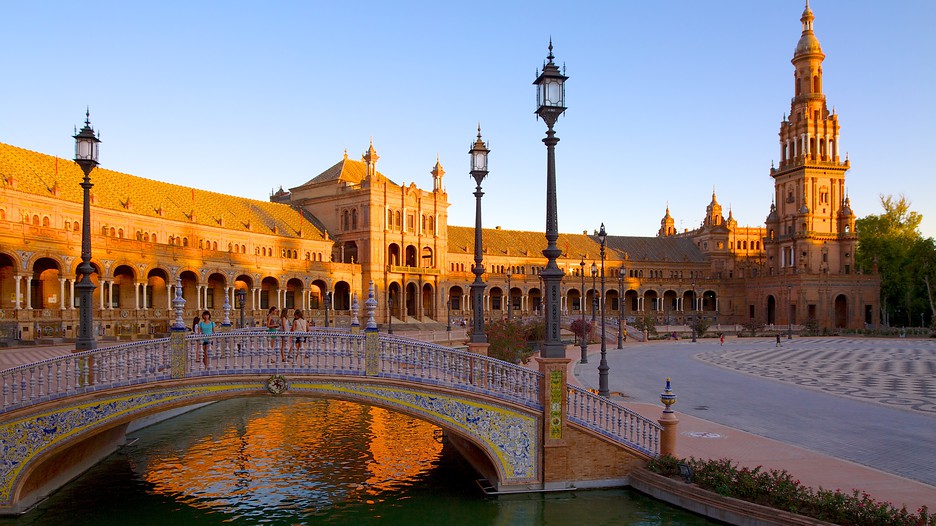
I was blessed to be able to visit Seville, Spain during my junior year abroad in college back in 1977.  My friend and I travelled by train to Andalucia during Holy Week.  This was during the era of Instamatic cameras, and I was a student on a limited budget, that did not include a lot of money for film and processing.  Nevertheless, I managed to get a few photos at "La Plaza de Espana", which was built in 1928 for the Ibero-American Exposition (like a World's Fair).  


I looked a lot different then! 


Seville is in the heart of Andalusia, and  Sevilla is the most important inland port of Spain. The port’s principal exports are wines, fruit, olives, cork, and minerals.  I visited a cork tree farm during the year I was in Spain, but it was further to the north.  Seville is famous for its bitter oranges.  Winter is the orange season in Seville, Spain. The trees are beautiful, but the Spanish don’t eat the bitter fruit. Instead, most of the oranges grown on local farms are exported to Britain to be made into marmalade.  According to an article on Springwise.com, the municipal water company, Emasesa, collects wasted fruit that falls on city streets, and uses it in an existing facility that generates electricity from organic matter. 

Sherry is produced in nearby Jerez de la Frontera and in the region.  

If you are interested in gardens and you go there, one not-to be missed place is the  Reales Alcázares and Gardens: In 1364 King Pedro I built his palace upon the site of a fortress dating back to the Moorish period. It took just two years to build including the surrounding gardens. Over the years different monarchs added to the palace and gardens. The Alcázares gardens are made up of different types of trees, pretty flowers, ponds,fountains, pavillions and terraces. The Patio del Yeso is an exquisite garden in which the flower beds and water channels dating back to the original 12th century fortress have been preserved.  I visited this garden during my travel.  


My little Instamatic photo does not show nearly the detail as the no-doubt professionally photographed image above.  Or perhaps, I have gotten a reflecting pool from Granada or Cordoba instead! 


Typical dishes in Seville include gazpacho, Andalucian stew (chickpeas and vegetables), Flamencan eggs, Sevillan style beef (which may be presented as a bull's tail), Sevillan style duck, prawn salad and spicy potato salad. 

I tried the Andalusian potato salad recipe from "The New Spanish Table" cookbook.   It consisted of boiled potatoes, mixed with peppers and onions and scallions and tomatoes, dressed with a sherry vinegar and olive oil.  I used white wine vinegar from my pantry, and it came out well.   There is also a recipe for gazpacho in this cookbook.  

Gazpacho is a cold tomato-based soup.  It is similar recipe to the tomato salad, but take out the potatoes and put in a cucumber and some bread crusts.  Here is a link to a typical recipe provided by Cooks Without Borders.  


One thing both recipes have in common is that they call for tomatoes.  Tomatoes were unknown in the "Old World" until they were introduced by the Spanish conquistadores exploring Peru.  The word "tomato" comes from  "tomatl," an Aztec word that is a very clear influence for the word tomato.  Additional history of how the tomato came to be used in the old world can be found on this web site on epicurean culture.   

I had high hopes for the "Matina" variety of tomatoes for my garden this year.  Matina is very early, salad sized tomato with heavy yield, good taste, and good disease resistance.   I started 72 plants from seed.  Unfortunately, only one survived the night of frost when I neglected to bring the seedlings in from the deck.   I am currently nursing the one plant along. I bought a few other tomato plants to replace the ones that were killed by frost, but I will not find "Matina" variety plants, I am sure.  I will try again next year.  I am going to have to be more careful, at my age I will not get too many more chances to replant next year. 

 There are going to be a few cold nights, into the 30's again, this week.  


Wednesday, November 25, 2020

Grand Tour - Rome countryside and fava beans

The next stop on the Grand Tour of Ohio is Rome.  There are at least three villages in Ohio named Rome.  My first stop will be in Richland County, since it is nearby.  

The traditional and modern cuisines of Rome, Italy is very typically what we think of as Italian food.  Pasta in all its shapes and variety, especially spaghetti.  Fresh vegetables abound.  Fava, or broad, beans are very typical and have been for centuries.   The specialty meats such as cured jowls, tripe, and oxtail were widely available due to the slaughterhouses of Rome, along with fish and seafood from the Mediterranean.  Cheeses such as the famous Peccorino Romano are eaten. 

Many of these foods were produced in the Roman Campagna (Italian: campagna romana), which is a low-lying area surrounding Rome.  In the Middle Ages, it was also a source of malaria, and so was abandoned for farming, supposedly also because the water supply was not adequate.  During the 17th through the 19th centuries, it was a source of inspiration for many landscape painters, and was a "required" stop on the Grand Tour.  


By Claude Lorrain - Unknown source, PublicDomain, https://commons.wikimedia.org/w/index.php?curid=1739828

The quality of the light in this picture reminds me of a photo I took in early October, 2019,  of my front lawn.  So, it's not impossible to think that I might be able to grow foods similar to those grown in the Roman countryside. 


A traditional Roman meal consists of five or six courses.  

Antipasto - an appetizer, perhaps a bruschetta or cured meats and marinated or fried vegetables in bite-sized pieces

Primo - usually a pasta dish. Rome has four : cacio e pepe (pecorino and pepper), carbonara (pecorino, guanciale, and egg), gricia (guanciale and pecorino), and amatriciana (guanciale, pecorino, and tomato).

Secondo - A piece of meat or fish, with vegetables ordered separately

Dolce - a sweet dessert. Perhaps tiramisu, a gelato, a piece of fruit

Coffee - no doubt an espresso or latte, my favorite, followed by a

Digestif - a liqueur such as amaretto, frangelico, grappa, limoncello

Martha Stewart offers us a recipe  for bruschetta with mint and fava beans. 


According to Johnny's Selected Seeds, fava beans like cool weather, like peas do.  I planted peas this year and the weather changed from cool to hot in a matter of a few days.  My peas withered on the vine faster than I could pick them.  The pods shattered later in summer, and when the weather was cool again, the pea seeds germinated and grew more plants.  The days are getting shorter and I doubt whether I will harvest any at all from this second crop.  

As hope springs eternal for a better garden success next year, I will order some fava bean seeds.  This is a crop I have never grown before. 


Related - why are Italian women so slim, compared to their American counterparts?

Thursday, November 12, 2020

Strasburg Mecklenberg-Vorpommern, Germany vs. Strasburg, Ohio, USA

 If you follow my bicycling blog, brightmeadowbicycle.blogspot.com, you know that I am doing a series "Grand Tour of Ohio on Bicycle" where I visit cities in Ohio that are named after European cities. 

This week I rode a loop starting in Strasburg, Ohio.  The town was settled by German immigrants and may have been named after Strasburg, Germany, although there is also a chance it was named after Strasbourg, France, which is a much larger city on the border with Germany.  


Agriculture and Wildlife preservation - there and here

In researching Strasburg, Germany, I found a link to the Deutsche Wildtier gut Klepelshagen.  This is a model farm run by the German Wildlife Federation that intends to demonstrate that wildlife preservation can co-exist with agriculture, and can be economically feasible.  

The sustainable practices that are followed there are late mowing, high mowing, and limited mowing on a daily basis, so that disturbed wildlife can find new homes.  Wide strips of non-cultivated land are left among the grazing organic German Angus beef cattle. They are managing the forests and woods by leaving fallen trees to rot and provide wildlife habitat, and managing the predator species by allowing sustainable hunting. 

"The German Wildlife Foundation manages almost 700 hectares of grassland as part of organic farming, which is expanded with additional requirements such as a late mowing date. The areas are mainly located in Fintel (Lower Saxony) and Klepelshagen (Mecklenburg-Western Pomerania) and are grazed with cattle or mowed for hay and silage use. Economic and ecological goals are linked to one another on these areas. The German Wildlife Foundation has received around 300 hectares of grassland from the federal government as part of the national natural heritage. The aim here is exclusively nature and species protection. The areas are mostly tended by organic farmers in terms of nature conservation. This benefits a variety of species: from the brown hare and the skylark to wild bees and butterflies. The areas are often characterized by special natural conditions, such as nutrient poverty (poor meadows) or high humidity (wet meadows). In addition, the German Wildlife Foundation has already converted arable land back into grassland at individual locations." - from the website. 

Near Strasburg, Ohio,  just outside of Dover, the Tuscarawas county Soil and Water Conservation organization runs the Norma Johnson Center, which is a wildlife preserve that offers opportunities to birders, naturalists, hikers and fishermen. Notably, bicycles are not allowed on the trails.  The preserve is located on Ohio State Route 39.  I am only a few miles away from this highway, I presume I could follow it all the way east to Dover. 

"As a young adult, Norma Johnson saw the beauty and impact of natural areas for all to enjoy. While farming and learning she realized that as the years go on highways and people would swell into the Brandywine Valley. She saw the need that “acres of trees, ponds, and wildlife would be most refreshing for people to wander over now and in the future”. With this vision and the efforts of the community the 303 acre Norma Johnson Center Conservation Center and Nature Preserve came to be for now and future generations."

Cuisine

Both Strasburgs, the German one, and the Ohio one, share a similar cuisine.  The Ohio region was settled by German immigrants and they brought their food heritage with them.  There is one difference, the German village is not too far from the Baltic Sea, so favorite saltwater seafood items like pickled herring and eel are not as common in Ohio,  although freshwater fish are widely available in lakes and rivers.

The website German Food Guide has this to say: 

The cuisine in Mecklenburg-Western Pomerania (Mecklenburg Vorpommen) is rich and hearty. Meat is used abundantly, as well as bacon and butter. Ham and wurst also play an important role in the cuisine here. Plums, pears, raisins, and apples are used as seasonings and side dishes for roasts.

Given the state's large amount of water from its lakes, rivers, and coastline, fish plays a large role in the cuisine. In the coastal regions, herring, mackerel, and flounder are the favorites, while perch, walleye, trout, and eel are the favorites inland.

The state's large forest areas provide its cuisine with a variety of game. Among the favorites are venison and wild boar.

A real Mecklenburg meal always includes potatoes, which is the favorite side dish here. Rice, dumplings, and noodles are usually only made from a package and then only when there is little time to prepare a "real" meal. But the locals would take pan fried potatoes made with bacon over these other side dishes in a heartbeat.

Other important vegetables here include kale, cabbage, beets, mushrooms, and beans.


On her website, Oma Gerhild mentions several favorite foods from Mecklenberg-Vorpommern. 

"Fish is popular, especially carp (Karpfen), eel (Aal), flounder (Flunder), pike (Hecht), bream (Brasse), roach (Rotauge), tench (Schleie), trout (Forelle), and salmonide (a type of German trout).

Cabbage (Kohl/Kraut)

Turnips (Rüben) and beets (Rote Rüben) used in salads, soups, and stews. The juices are used to make syrups and sweeteners.

Geese (Gänse) considered the best of poultry with apples, prunes, and bread stuffing.

Hotchpotch a meat, turnip, carrot, and cabbage

Eintopf ("onepot")

Tollatsch a sweet black pudding made with pig's blood, raisins, and sugar. Of Swedish origin, it is eaten sliced, fried, and sprinkled with sugar."


And the website Germanfoods.org lists other favorites. 

 Mecklenburg-Vorpommern (Mecklenburg-West Pommerania) is Germany’s most agrarian state with an abundance of farms producing dairy products, fruits and vegetables, fish and cereals.

Aal in Dillsosse (Eel in a Dill Sauce) -A common dish from the Mecklenburg-Vorpommern region of Germany with marinated eel.

Gebratener Hornhechte (Fried Horn Fish) -This fried dish is one of many welcoming summer to the Ostsee coast.

Klopfschinken (Breaded Ham)-Crispy breaded ham is a favorite in the northeastern region of Germany.

Labskaus (Corned Beef, Potatoes, and Onions)- A traditional meal that is simple, yet sophisticated.

Marinated Fried Herring -A perfect Fish-Fry-Friday dish!

Mecklenburger Fischsuppe (Fish Soup)-Greatly paired with dark bread and a beer!

Rote GrĂĽtze-A summer dessert with delicious berries. Top with whipped cream or serve over ice cream for extra sweetness.

Sanddorn-Mandel-Kuchen (Sea Buckthorn Berry-Almond Cake)- A sweet orange marmalade glaze completes this cake.

Schweinebraten gefĂĽllt mit Backpflaumen (Roasted Pork with Prunes)-The sweet and sour flavor typical to Mecklenburg-Vorpommern is show-cased in this heavenly dish.

Königsberger Klopse (Kaliningrad Meatballs)

Räucherfischbrötchen

Geräucherter Lachs mit Forellenfilets

Deutscher Käsekuchen

 I found "arme ritter" listed on Wikipedia's page about Mecklenberg cuisine.  Since my maiden name was Ritter, I wondered what this food was.  Translated literally, it means "poor knight".  The wikipedia article links to an article on French toast, fried bread slices dipped in egg!  Evidently that is what poor knights ate!  

Friday, November 06, 2020

Paris kitchen garden

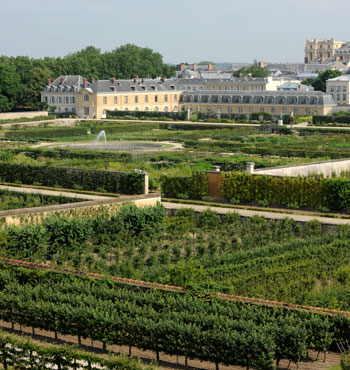
A couple of days ago, I visited Paris, Ohio.  I wrote about it on my bicycling blog.  There is no comparison to Paris, France.  As part of my research, I looked up kitchen gardens near Paris and I stumbled on The kitchen garden of Saint Jean de Beauregard, supposedly one of the most beautiful gardens in France. 


The website for the garden describes it "This kitchen garden, completely walled like most 17th century kitchen gardens, is one of the few castle kitchen gardens to have survived intact. A masterpiece of the art of the flowering kitchen garden, this garden of delights covers two hectares and houses a whole host of rare and forgotten flowers, fruit and vegetables in a series of beautiful, continually renewed compositions. Among the paths branching out from the central pond hide glasshouses for grapes, a fruit cellar and an astonishing grape storage chamber. The restoration of this garden in 1984 was made possible by the discovery of its original plans in the chateau’s archives. Classified Historic Monument in 1993 and recognized as Jardin Remarquable in 2005, this outstanding garden is a choice destination for garden lovers from all over the world and a source of constant inspiration for many gardeners."

While you plan your trip, you may also consider visiting the "farmer's market" in Paris on a Saturday, the market of Batignolles.  


After you pick up some vegetables at the market, you may want to cook something French.  I highly recommend making a Quiche Lorraine, or as this website calls it, an onion tart. Bacon is optional. 


Friday, October 23, 2020

Garden getting ready for winter


We had an early frost last week.  I had intended to take some cuttings from the tomato plants to see if I could overwinter them, but it didn't happen. The predicted frost did happen, though. I pulled up all the landscaping fabric pieces that were between the rows of my tomato plants,and removed and untangled the tomato cages from the vines.  Ed helped me by stacking the cages and removing the remaining fence posts from the deer fence we took down a few weeks ago. 
I put the tomato vines into my compost pile, as you can see, the vines dwarf the composter. There were hundreds of yellow jackets hovering around the composter. They did not bother me, but Ed got stung twice.   Ed suggested putting the vines through the chipper/shredder, which is in the garage at the bottom of the hill.  I did not relish fighting to bring the chipper uphill.  He evidently didn't, either. I found a few thistles which I pulled to garnish the top of the pile. 


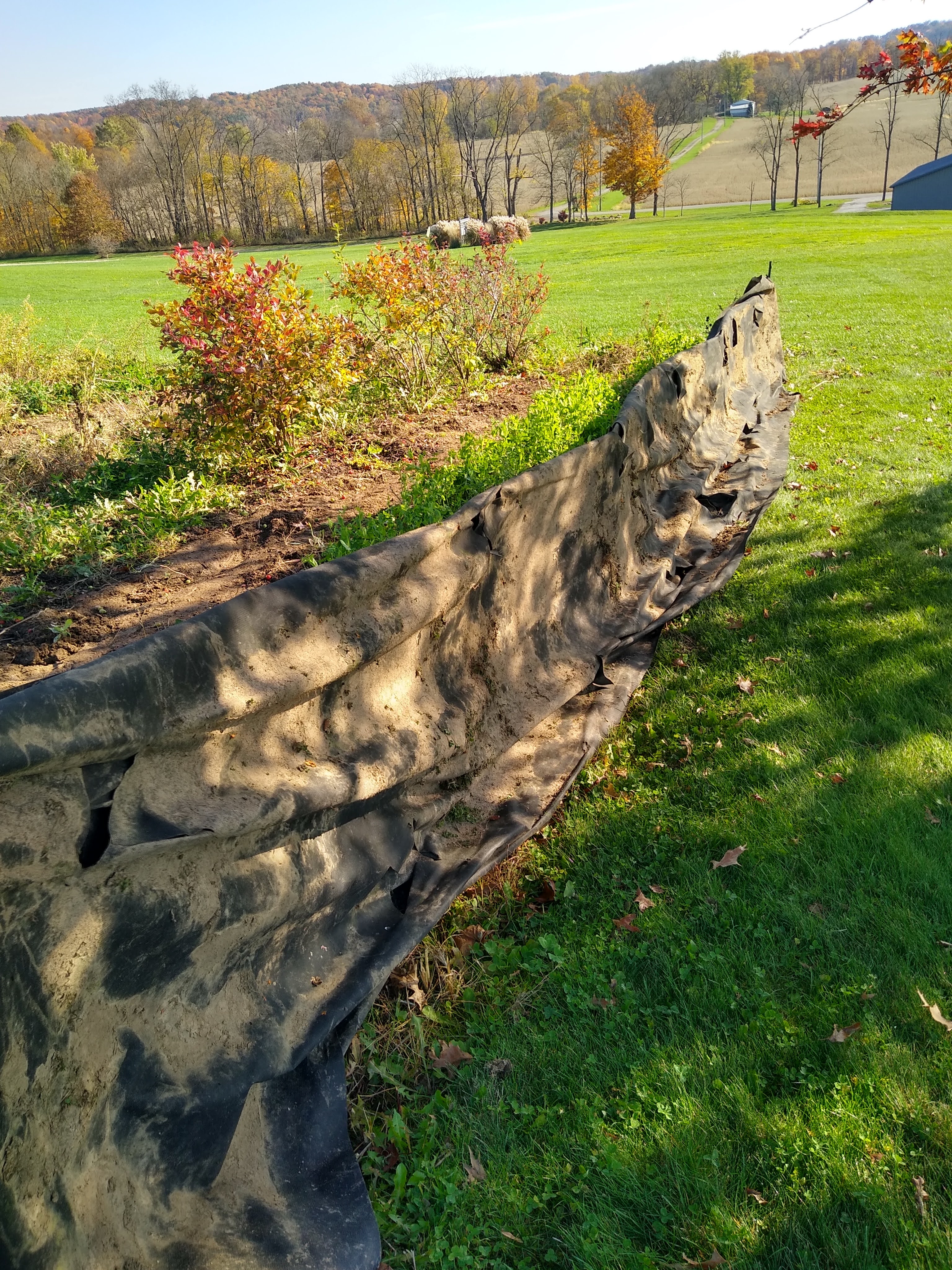
I draped the landscape fabric pieces over the pea fence, since the larger deer fence was gone.  The fabric was quite wet with composted weeds and soil on top of the fabric, which I shook into a pile at the edge of the garden.  The wind should dry them out in a few days. Then I can roll them up and put them away for the winter.   I am debating whether it is too late to plant lettuce, or at least microgreens, in the weedless soil that was under the fabric.  

My second crop of peas is doing well, was not damaged at all by the frost. They self-seeded when the snow peas I planted in early spring ripened and dried up in the space of a few days during our early summer heat.  The plants are starting to blossom.  Hopefully the weather will stay nice long enough to harvest some snow peas.  I have had fancy restaurants serve the tender tendrils on salads, so that is still an option. 


I noticed that the blueberry bushes could do with some pruning.  That is next on the list. 

Friday, October 16, 2020

The King's Vegetable Garden - Versailles, France

 On another of my blogs, Brightmeadow on Bicycles, I am writing about my latest goal of planning and executing bicycle rides through the cities in Ohio that are named after European cities.  The Grand Tour, if you will.  In the 1600's and 1700's, wealthy young men, and some young ladies, were encouraged to complete a year or two travelling through the different capitals of Europe.  If you have a mindset more like my husband's, you may also be familiar with the British TV show, The Grand Tour, where three journalists take trips to various globale locales to drive cars (and sometimes wreck them) through tortuous terrain. My journeys will not involve the wrecking of any bicycles. 

My most recent bicycle Grand Tour trip was to Versailles, Ohio.  I researched the city of Versailles, France, for contrast.  Versailles is a suburb of Paris, and has much of the same cachet.  Versailles was the site of the French Court during the reign of the monarchs Louis XIV through Louis XVI.  And it was also the birthplace of the French Revolution. 

One of the monuments of the French Palace of Versailles, a UNESCO World Heritage site,  was the King's Vegetable Garden,   "Le potager-du-roi" in French. It was opened to the public for tours in 1991. It's gardeners perpetuate the art of pruning and cultivate a wide variety of fruits and vegetables in a French garden.

"Louis XIV commissioned Jean-Baptiste de La Quintinie to develop a kitchen garden on the site of a swamp known as 'stinking pond'. Construction lasted from 1678 to 1683 and it had to demonstrate ingenuity to overcome the swampy terrain. This explains the use of an underground aqueduct, rubble drains and raised beds. Over time, the kitchen garden has pretty much retained La Quintinie's original design – so you will still find a succession of gardens surrounded by walls and dominated by terraces" - Versailles Tourism site


"The soil was bad but luckily, there were plenty of horses in the King’s stables to provide tons of manure. The open land didn’t provide enough protection to heat loving fruit and vegetables. So, La Quintinie designed the garden as a series of large rooms. He dug down, improved the soil and separated areas with high stone walls and terraces to trap the sun and keep the heat in. It was innovative and exciting gardening and enabled him to grow plants that usually only thrive in the far south.

It was said he could provide up to 4000 figs and 150 melons a day. Lettuces were grown in January. Strawberries were ripe in March. Coffee beans and bananas were grown, as by 1685 glass making techniques meant greenhouse conditions could be created. The underground heating kept roots healthy even in the dead of winter. Louis would show off the area to foreign visitors, it became one of the most famous gardens of its time. " from the website The Good Life France.

A fellow blogger, Jill Colonna of Mad About Macarons and Teatime in Paris wrote about her experience there. It inspired her to make a red onion Chevre Tartin.  The link to her recipe on that page is no longer working, but I found her recipe elsewhere on her blog.   I do not have prepared puff pastry dough on hand, but I do have flour and butter and lard.  I have previously and successfully used this recipe from Penelope Casas for puff pastry, and I have some fresh black walnut meats from trees in our yard that I painstakingly picked out earlier today.  I will serve with pears from our orchard. 

At the moment I have two dozen or so quart canning jars in the dishwasher.  Ed was able to source some jar lids from China for me.  I am still waiting for the ones I ordered from Lehman's hardware. I will be canning apples picked last week in Michigan as soon as the cycle is finished.  


Friday, October 09, 2020

Marigold Seeds

 I rode my bike on the Marion Tallgrass Trail yesterday.  At each intersection along the trail, there were flowerbeds in the center of the trail, instead of the traditional bollards which warn riders of an intersection. 

At the trailhead, there were some really beautiful marigolds of three different varieties. Or perhaps one variety with three different appearances.   I collected a couple of dried blossoms with the seeds.  I'm afraid I lost some when I took my phone out of the case, but I have  put the rest in an envelope for planting next spring.  I hope that some are viable!  Perhaps they will hybridize and I will get something completely new. 


Wednesday, October 07, 2020


These seed packets were waiting for me when we arrived home last night.  I recently read an article about Matina tomatoes.  I've been planting Bloody Butcher and Fourth of July and Independence Day salad tomatoes for the last 15 years.  They are all early, small tomatoes.  I rarely harvest any by the actual fourth of July, but usually have some by mid-July.  I suspected that they were all really the same variety, so I did a google search to look for comparisons.  Instead, I found this Matina variety that had rave reviews.  Since it is so late in the season, I was afraid I would not remember the name for next year, so I went ahead and ordered this year's seeds.  This is a new seed company for me.  Service was fantastic, I received the seeds two days after I ordered them.    

From their web site: 
"We don’t want to make crazy, bold proclamations after so short a time of getting to know a new variety (which, as you can tell from the intro, means we are going to anyway) but Matina might be our best all-around slicing tomato. It’s nice to be a small family company where we can write something like that and not break down into staff fistfights. It just checks all the boxes for us and exceptionally so: sets very early but with sustained harvests through fall, strong vigorous growth, beautifully organized and prolific trussing, perfect blemish-free and very uniform fruit, and a great flavor balance of sweet and acid. I reckon we harvested about 400+lbs of fruit from 30 field-grown plants in the summer of 2016! At 4-6 oz, the fruits are a little larger than Stupice,  slightly flattened, and just the flawless ideal of a tomato in appearance. One of Carolyn Male's “100 Heirloom Tomatoes for the American Garden” it hails from Germany, where our seed was originally sourced. This should be a nursery standard in the PNW.  (Crowned taste test winner at two Organic Seed Alliance trial events of early red slicers in 2017)
Indeterminate/Potato Leaf. 65-70 days. UO"

As far as the zuchini variety, it is also new to me. This year I planted Burpee's Best zuchini, Of the five hills I planted, two were excellent and healthy, the others did not do so well.  I picked about 20 zuchinis, then the plants just fizzled out, dried up and turned brown.   

This is the first year gardening in this garden, so I haven't added a lot of soil amendments yet.  I learned that the previous owner "salted" her asparagus patch to kill weeds, and I had planted the zuchini downhill from the asparagus, so perhaps that accounts for the poor performance.  From the seed company, Dark Star description: 

"(C. pepo) Market growers take note. Here is a zuke to rival all the corporate-owned hybrids currently hijacking the zucchini market. Bred by Bill Reynolds of Eel River Produce in Northern CA & John Navazio, Dark Star was selected in part for vigorous root growth to excel in dry farming conditions.  What struck us though is the quality of the fruit, by far the most refined OP zuke we’ve seen with very uniform long, dark green, angular fruit. While not as productive at its peak as some (though certainly no slouch), it sustained its productivity over a longer period than others we’ve grown. Open habit makes it easy to pick. Recommended for the home garden or by the acre. The best OP standard zuke on the market. (Update: during the freakish frosts in Baja in the winter of 2011 Dark Star was likely the only organic zucchini in grocery stores. Just a degree or two more cold hardiness kept it alive amidst a sea of frost killed neighboring fields)

50-55 days. SR" 


Tuesday, September 29, 2020

Back to your regularly scheduled programming.

Life on the farm.  Or at least the suburban garden.  This year I planted a full tray of 72 tomato plants of several different varieties.  I neglected watering them a few times, because my plant starting stand is in Ed's garage and I was in the warm house.  So I planted the ones that survived in the garden.  It turned out mostly the new variety of grape tomato (cherry-sized) plants survived.  I also had a few Bloody Butcher/Fourth of July tomato variety plants survive.  And I went to the garden center for a Better Boy plant.

I've been picking a lot of tomatoes.  Over the course of the summer and now fall, I have harvested at least eight of the big round containers.   I also had some hot wax peppers survive my neglect.  I have canned over 50 pints of salsa. As usual, each batch has a different degree of hotness depending on the variety of pepper I use.  


It was an interesting experience to make salsa out of cherry tomatoes instead of the large Big-Boys I usually use.  I gave them a turn in the food processor with the onions and the peppers and they diced up very well. 
 

I have also been canning apple sauce.  Early in August before I started my bike ride, I made a batch of applesauce from the Yellow Transparent apples I picked in Michigan.
  
Yesterday, Ed helped me can 20 pints of applesauce from a bushel of Jonathon apples.  I am labelling the jars with the apple variety.  It is almost like fine wines.  You can see the difference in color between the yellow Transparent apples and the red-skinned Jonathons. 


I still have some Grimes golden apples in the garage to process, and also a bushel of Crimson Delicious. I don't think the Delicious apples hold up to cooking well, so I will see what I can find about how to use them.    

I also made a batch of hot pepper jelly.  I had never tried this before until at a church luncheon in Michigan, when someone served a brick of cream cheese with hot pepper jelly spread on the top.  The combination was fantastic, the spiciness and creaminess set off all kinds of buzzers in my taste buds!  I hope my jelly sets up, right now it is looking a little bit runny.  I understand it can take up to 24 hours to set.  I used fresh pectin and apple juice left from the apple sauce process, so there should be plenty of pectin to make it set.  I added a few drops of red food coloring to make it interesting. 


I'm not an affiliate, but here is a link to a recipe from Kraft-Heinz for a similar appetizer in phyllo cups. 

Now that I have labelled the jars, all I have to do is clean up the kitchen.  

I have set up a separate page on the blog to record any future bike riding adventures.  

 
© Bright Meadow Blog · Privacy Policy · Terms of Use