. Bright Meadow Farms: Grand Tour

Search This Blog

Showing posts with label Grand Tour. Show all posts

Monday, May 03, 2021

Gardens, recipes, and travels in Seville Spain

 I recently travelled to Seville, Ohio as part of my "Grand Tour" of Ohio cities named after European capitols.  You can read about my trip on my "BrightMeadow on Bicycle" blog.

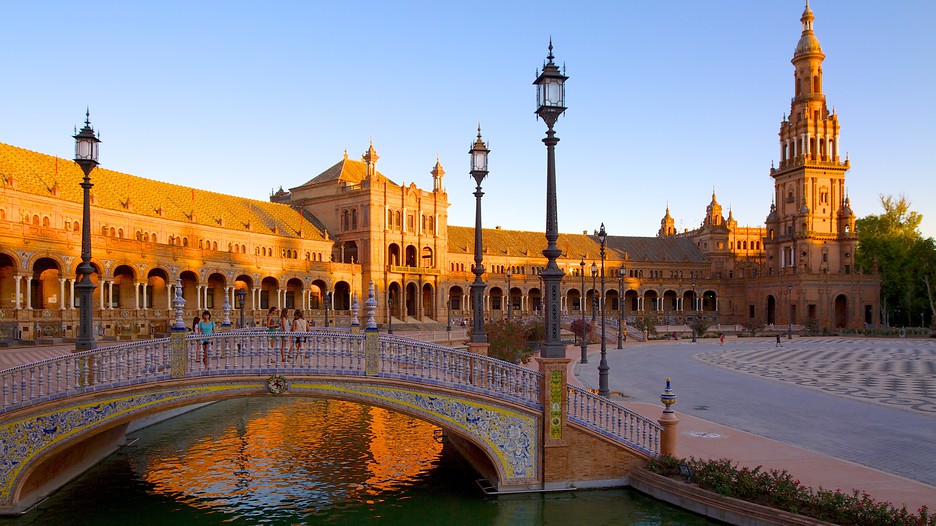
I was blessed to be able to visit Seville, Spain during my junior year abroad in college back in 1977.  My friend and I travelled by train to Andalucia during Holy Week.  This was during the era of Instamatic cameras, and I was a student on a limited budget, that did not include a lot of money for film and processing.  Nevertheless, I managed to get a few photos at "La Plaza de Espana", which was built in 1928 for the Ibero-American Exposition (like a World's Fair).  


I looked a lot different then! 


Seville is in the heart of Andalusia, and  Sevilla is the most important inland port of Spain. The port’s principal exports are wines, fruit, olives, cork, and minerals.  I visited a cork tree farm during the year I was in Spain, but it was further to the north.  Seville is famous for its bitter oranges.  Winter is the orange season in Seville, Spain. The trees are beautiful, but the Spanish don’t eat the bitter fruit. Instead, most of the oranges grown on local farms are exported to Britain to be made into marmalade.  According to an article on Springwise.com, the municipal water company, Emasesa, collects wasted fruit that falls on city streets, and uses it in an existing facility that generates electricity from organic matter. 

Sherry is produced in nearby Jerez de la Frontera and in the region.  

If you are interested in gardens and you go there, one not-to be missed place is the  Reales Alcázares and Gardens: In 1364 King Pedro I built his palace upon the site of a fortress dating back to the Moorish period. It took just two years to build including the surrounding gardens. Over the years different monarchs added to the palace and gardens. The Alcázares gardens are made up of different types of trees, pretty flowers, ponds,fountains, pavillions and terraces. The Patio del Yeso is an exquisite garden in which the flower beds and water channels dating back to the original 12th century fortress have been preserved.  I visited this garden during my travel.  


My little Instamatic photo does not show nearly the detail as the no-doubt professionally photographed image above.  Or perhaps, I have gotten a reflecting pool from Granada or Cordoba instead! 


Typical dishes in Seville include gazpacho, Andalucian stew (chickpeas and vegetables), Flamencan eggs, Sevillan style beef (which may be presented as a bull's tail), Sevillan style duck, prawn salad and spicy potato salad. 

I tried the Andalusian potato salad recipe from "The New Spanish Table" cookbook.   It consisted of boiled potatoes, mixed with peppers and onions and scallions and tomatoes, dressed with a sherry vinegar and olive oil.  I used white wine vinegar from my pantry, and it came out well.   There is also a recipe for gazpacho in this cookbook.  

Gazpacho is a cold tomato-based soup.  It is similar recipe to the tomato salad, but take out the potatoes and put in a cucumber and some bread crusts.  Here is a link to a typical recipe provided by Cooks Without Borders.  


One thing both recipes have in common is that they call for tomatoes.  Tomatoes were unknown in the "Old World" until they were introduced by the Spanish conquistadores exploring Peru.  The word "tomato" comes from  "tomatl," an Aztec word that is a very clear influence for the word tomato.  Additional history of how the tomato came to be used in the old world can be found on this web site on epicurean culture.   

I had high hopes for the "Matina" variety of tomatoes for my garden this year.  Matina is very early, salad sized tomato with heavy yield, good taste, and good disease resistance.   I started 72 plants from seed.  Unfortunately, only one survived the night of frost when I neglected to bring the seedlings in from the deck.   I am currently nursing the one plant along. I bought a few other tomato plants to replace the ones that were killed by frost, but I will not find "Matina" variety plants, I am sure.  I will try again next year.  I am going to have to be more careful, at my age I will not get too many more chances to replant next year. 

 There are going to be a few cold nights, into the 30's again, this week.  


Wednesday, November 25, 2020

Grand Tour - Rome countryside and fava beans

The next stop on the Grand Tour of Ohio is Rome.  There are at least three villages in Ohio named Rome.  My first stop will be in Richland County, since it is nearby.  

The traditional and modern cuisines of Rome, Italy is very typically what we think of as Italian food.  Pasta in all its shapes and variety, especially spaghetti.  Fresh vegetables abound.  Fava, or broad, beans are very typical and have been for centuries.   The specialty meats such as cured jowls, tripe, and oxtail were widely available due to the slaughterhouses of Rome, along with fish and seafood from the Mediterranean.  Cheeses such as the famous Peccorino Romano are eaten. 

Many of these foods were produced in the Roman Campagna (Italian: campagna romana), which is a low-lying area surrounding Rome.  In the Middle Ages, it was also a source of malaria, and so was abandoned for farming, supposedly also because the water supply was not adequate.  During the 17th through the 19th centuries, it was a source of inspiration for many landscape painters, and was a "required" stop on the Grand Tour.  


By Claude Lorrain - Unknown source, PublicDomain, https://commons.wikimedia.org/w/index.php?curid=1739828

The quality of the light in this picture reminds me of a photo I took in early October, 2019,  of my front lawn.  So, it's not impossible to think that I might be able to grow foods similar to those grown in the Roman countryside. 


A traditional Roman meal consists of five or six courses.  

Antipasto - an appetizer, perhaps a bruschetta or cured meats and marinated or fried vegetables in bite-sized pieces

Primo - usually a pasta dish. Rome has four : cacio e pepe (pecorino and pepper), carbonara (pecorino, guanciale, and egg), gricia (guanciale and pecorino), and amatriciana (guanciale, pecorino, and tomato).

Secondo - A piece of meat or fish, with vegetables ordered separately

Dolce - a sweet dessert. Perhaps tiramisu, a gelato, a piece of fruit

Coffee - no doubt an espresso or latte, my favorite, followed by a

Digestif - a liqueur such as amaretto, frangelico, grappa, limoncello

Martha Stewart offers us a recipe  for bruschetta with mint and fava beans. 


According to Johnny's Selected Seeds, fava beans like cool weather, like peas do.  I planted peas this year and the weather changed from cool to hot in a matter of a few days.  My peas withered on the vine faster than I could pick them.  The pods shattered later in summer, and when the weather was cool again, the pea seeds germinated and grew more plants.  The days are getting shorter and I doubt whether I will harvest any at all from this second crop.  

As hope springs eternal for a better garden success next year, I will order some fava bean seeds.  This is a crop I have never grown before. 


Related - why are Italian women so slim, compared to their American counterparts?

Friday, November 06, 2020

Paris kitchen garden

A couple of days ago, I visited Paris, Ohio.  I wrote about it on my bicycling blog.  There is no comparison to Paris, France.  As part of my research, I looked up kitchen gardens near Paris and I stumbled on The kitchen garden of Saint Jean de Beauregard, supposedly one of the most beautiful gardens in France. 


The website for the garden describes it "This kitchen garden, completely walled like most 17th century kitchen gardens, is one of the few castle kitchen gardens to have survived intact. A masterpiece of the art of the flowering kitchen garden, this garden of delights covers two hectares and houses a whole host of rare and forgotten flowers, fruit and vegetables in a series of beautiful, continually renewed compositions. Among the paths branching out from the central pond hide glasshouses for grapes, a fruit cellar and an astonishing grape storage chamber. The restoration of this garden in 1984 was made possible by the discovery of its original plans in the chateau’s archives. Classified Historic Monument in 1993 and recognized as Jardin Remarquable in 2005, this outstanding garden is a choice destination for garden lovers from all over the world and a source of constant inspiration for many gardeners."

While you plan your trip, you may also consider visiting the "farmer's market" in Paris on a Saturday, the market of Batignolles.  


After you pick up some vegetables at the market, you may want to cook something French.  I highly recommend making a Quiche Lorraine, or as this website calls it, an onion tart. Bacon is optional. 


© Bright Meadow Blog · Privacy Policy · Terms of Use